Help your students master the basic math facts

A strategy-based approach to math fact fluency.

A Different Kind of Math Fact Fluency Website

MathFactLab is teacher-created, and we've taken the advice of the world's best researchers of mathematics education to build a website for online math fact fluency practice that is based on reasoning strategies and sense-making.
There are dozens of math facts programs on the market, some glossier than others, but they all generally rely on the same ineffective method: rote memorization through drill.
MathFactLab students are not asked to blindly memorize facts. Instead, by engaging with multiple models - such as number lines, area models, bar diagrams, ten frames, dice, beads, coins, and clock faces - our students enhance their number sense as they construct a deep understanding of the basic math facts.
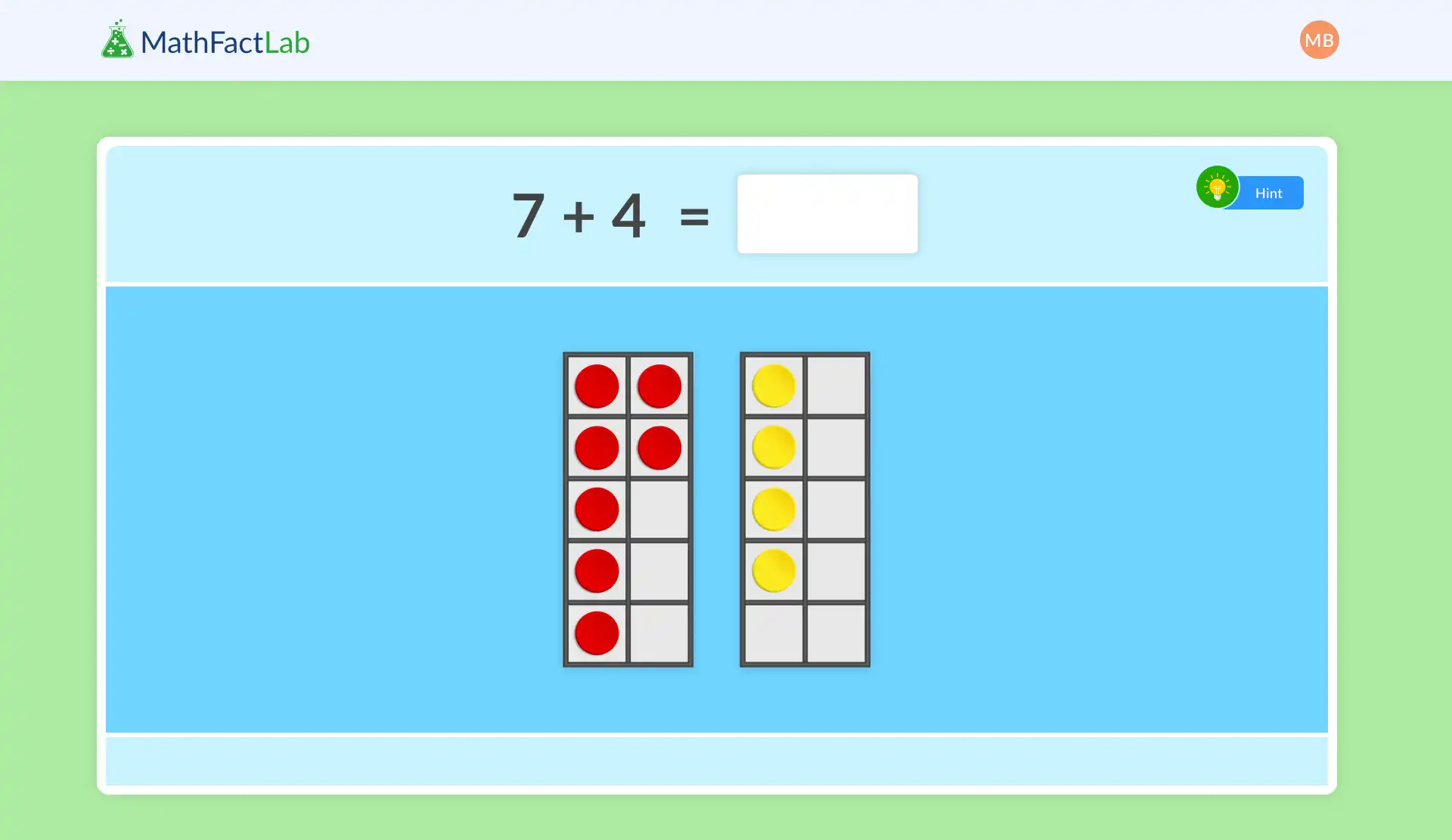
MathFactLab addition problem 7 plus 4 equals with ten-frame visual aids showing seven red dots and four yellow dots.
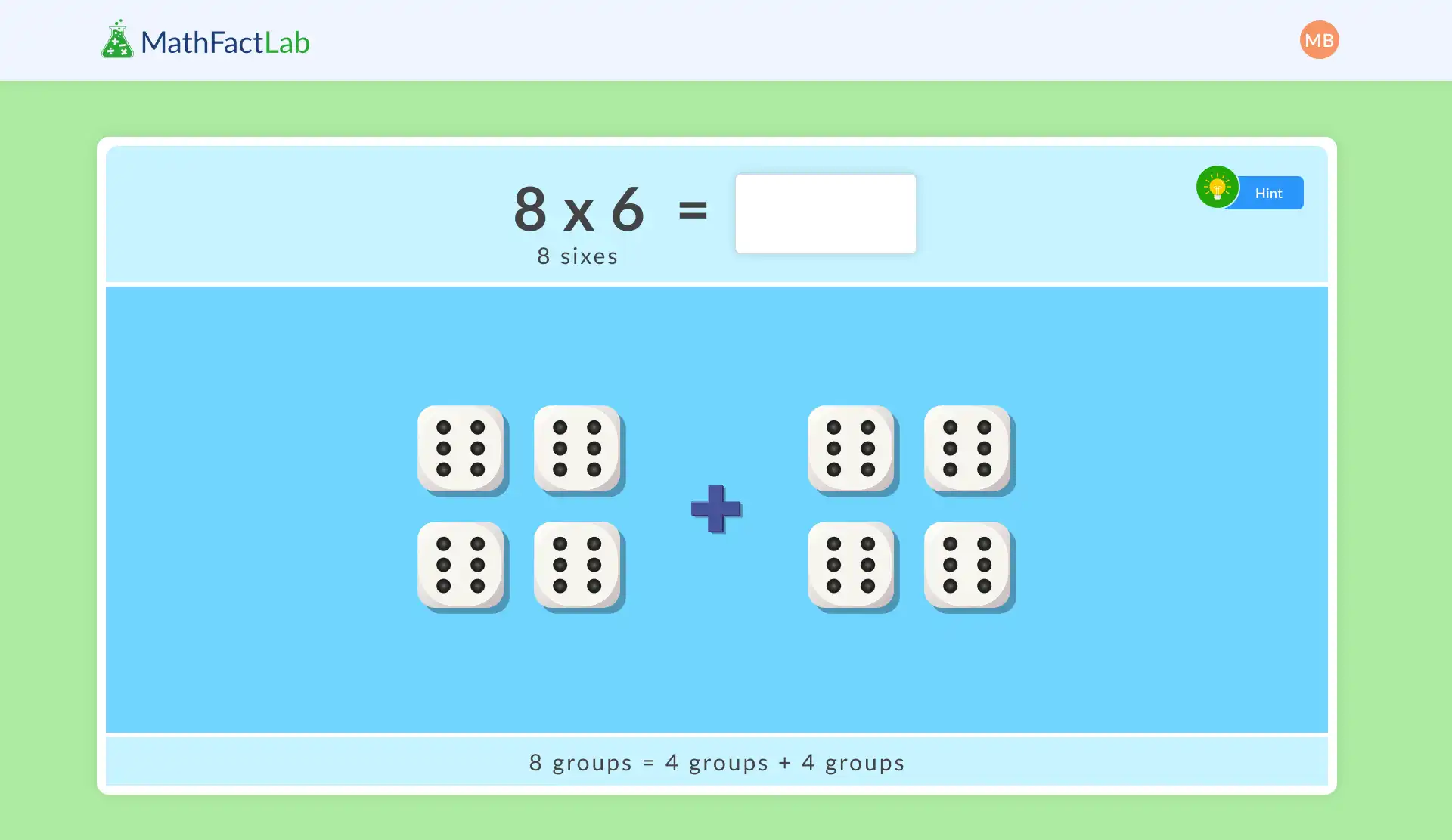
MathFactLab multiplication problem showing 8 times 6 equals blank with illustration of eight dice showing six dots grouped as two sets of four dice plus sign between them, and text reading '8 groups = 4 groups + 4 groups'.
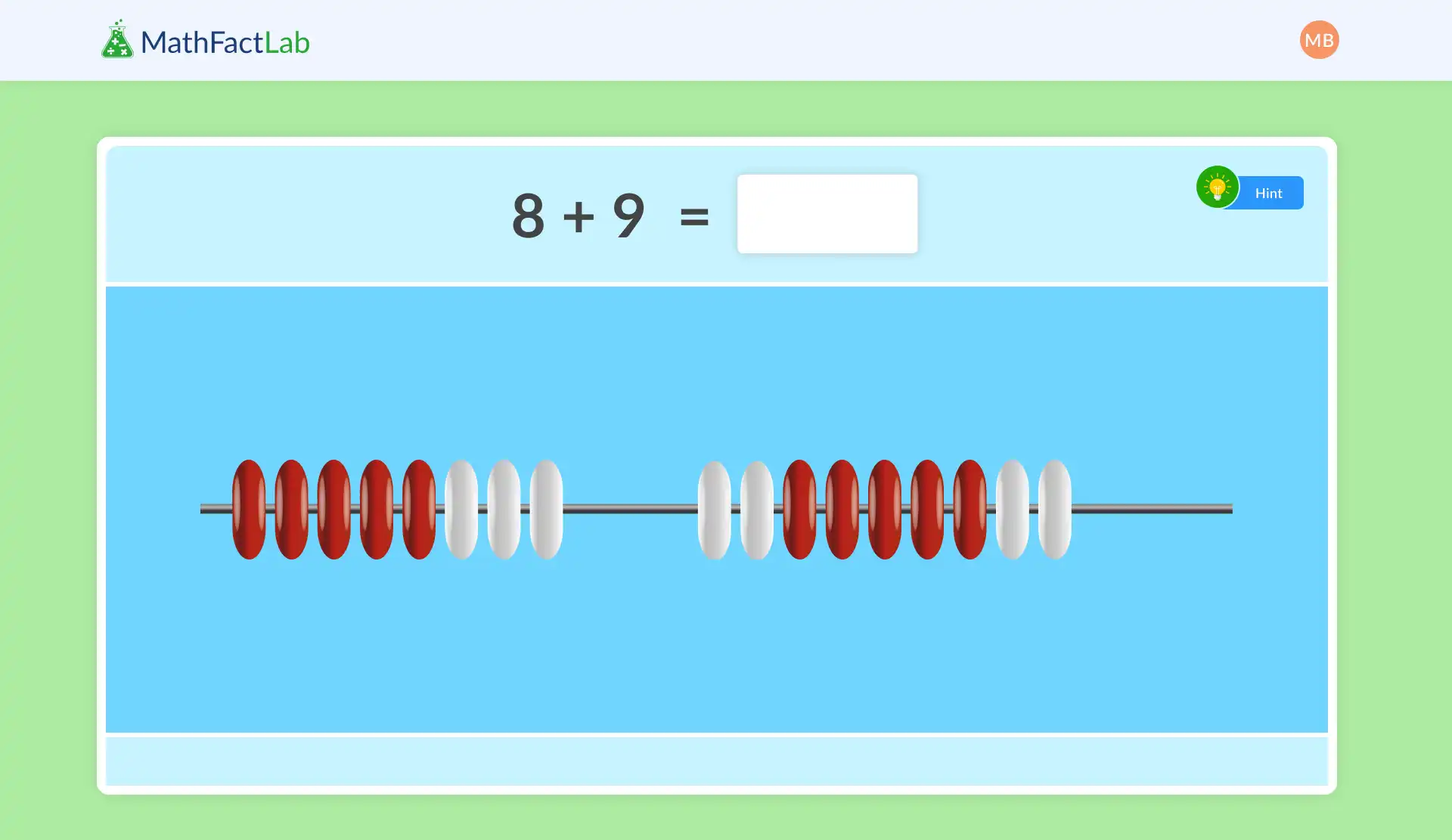
MathFactLab addition problem 8 plus 9 equals with an abacus showing 17 beads.
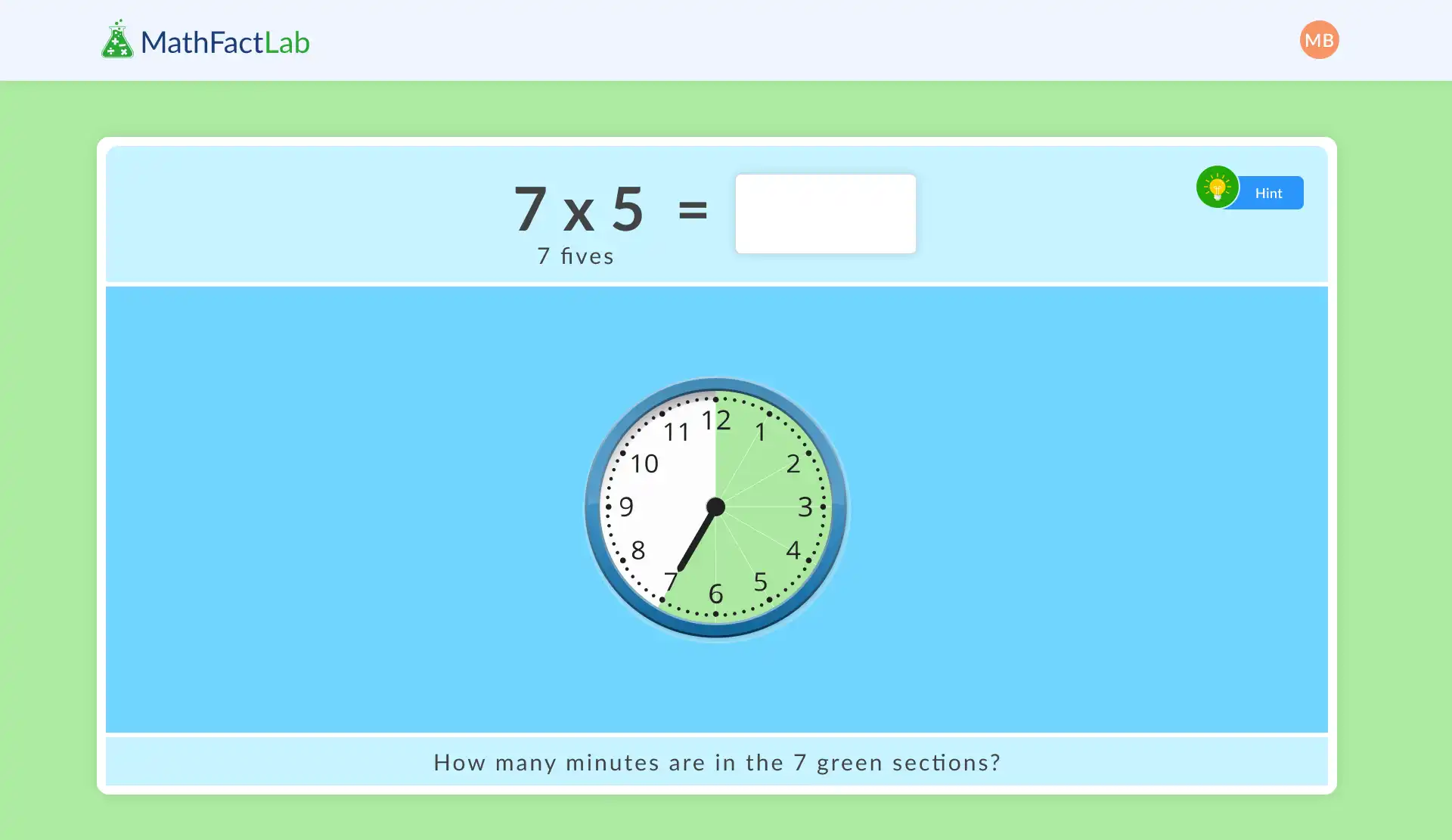
MathFactLab multiplication problem 7 x 5 with a clock showing 7 green sections representing 35 minutes, asking how many minutes are in the 7 green sections.
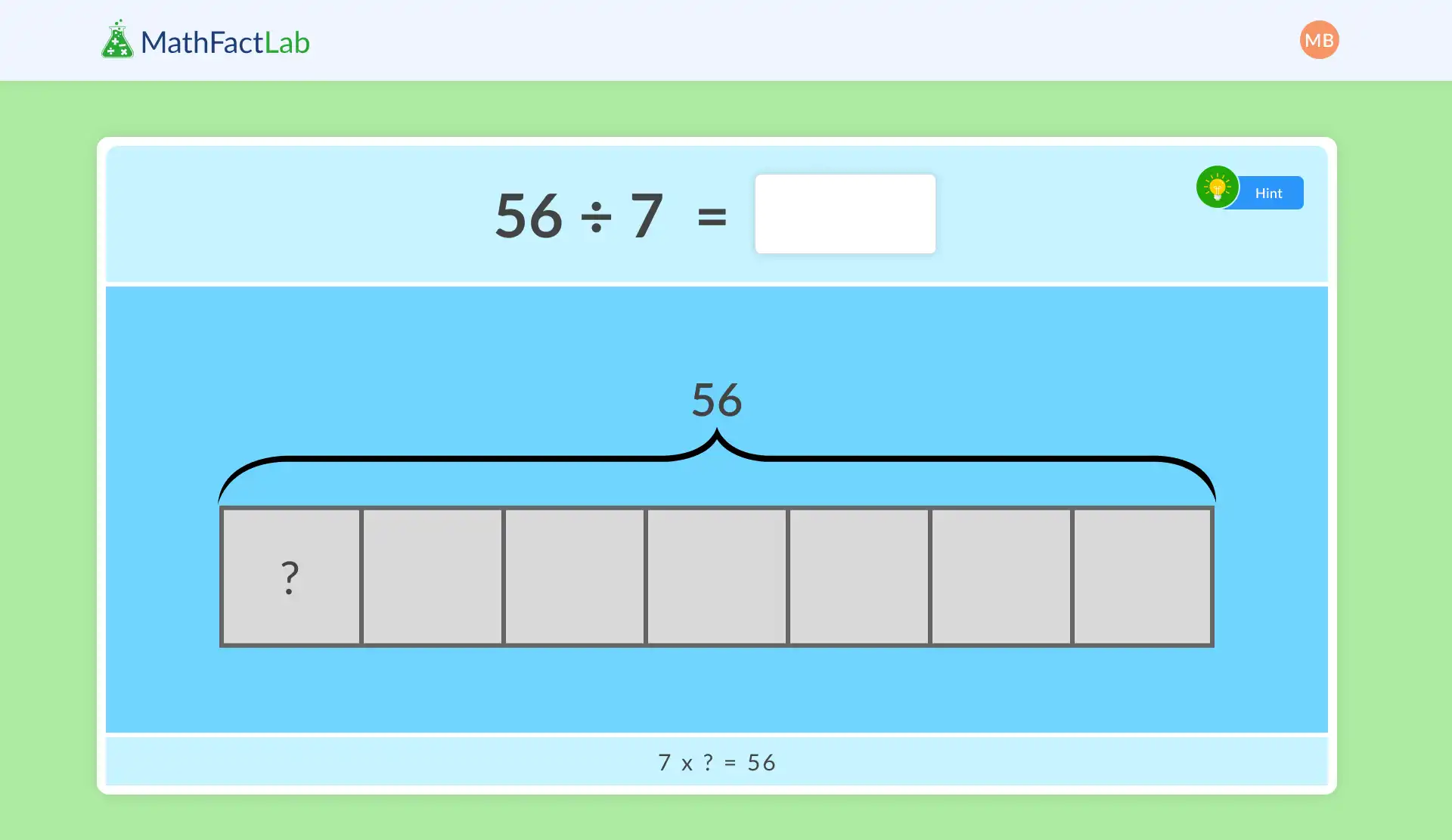
MathFactLab division problem 56 ÷ 7 with seven empty boxes representing equal parts, showing 7 times a missing number equals 56.
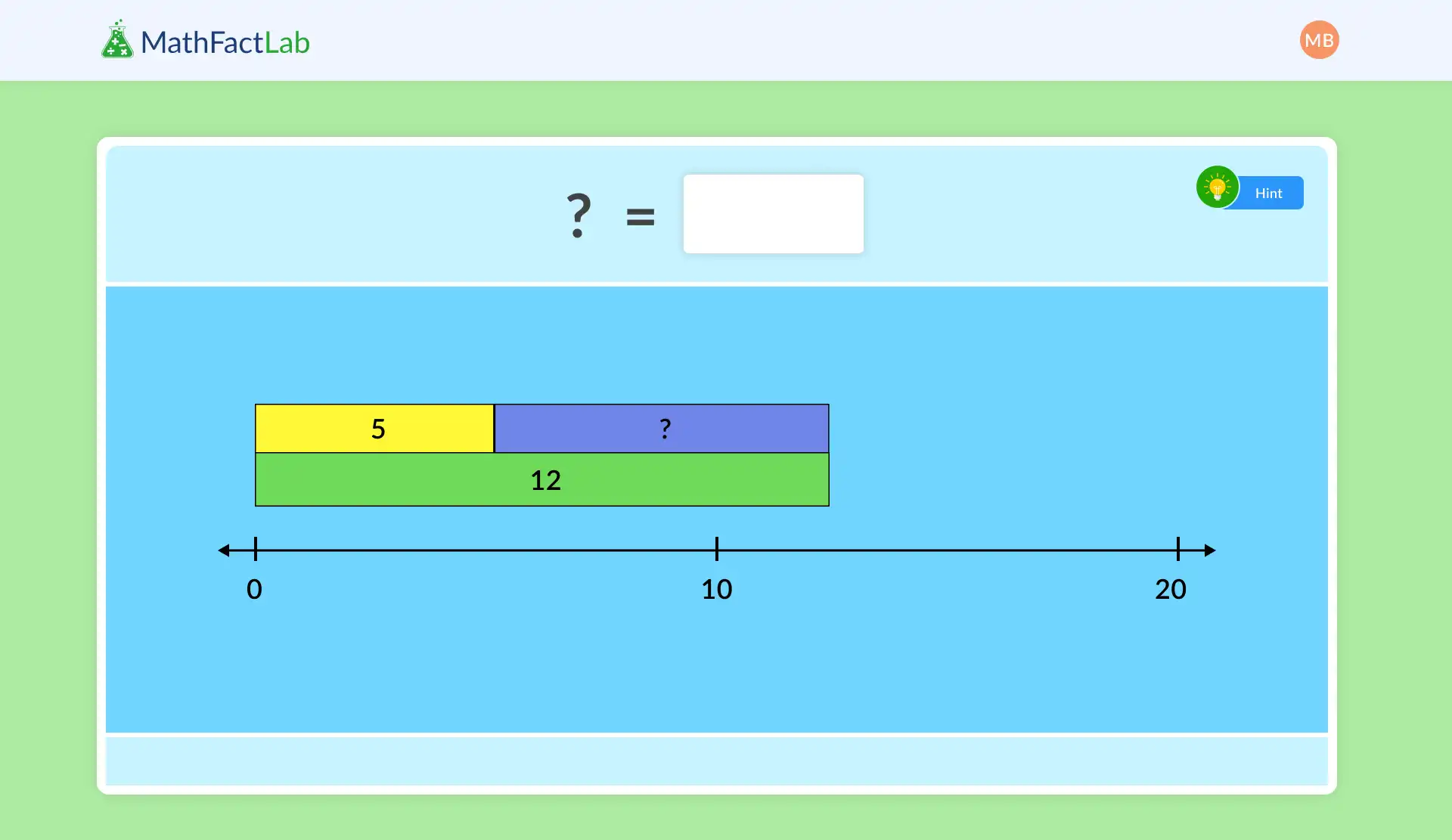
MathFactLab number line showing segments 5 and unknown length adding to 12, with zero, 10, and 20 marked on the line.
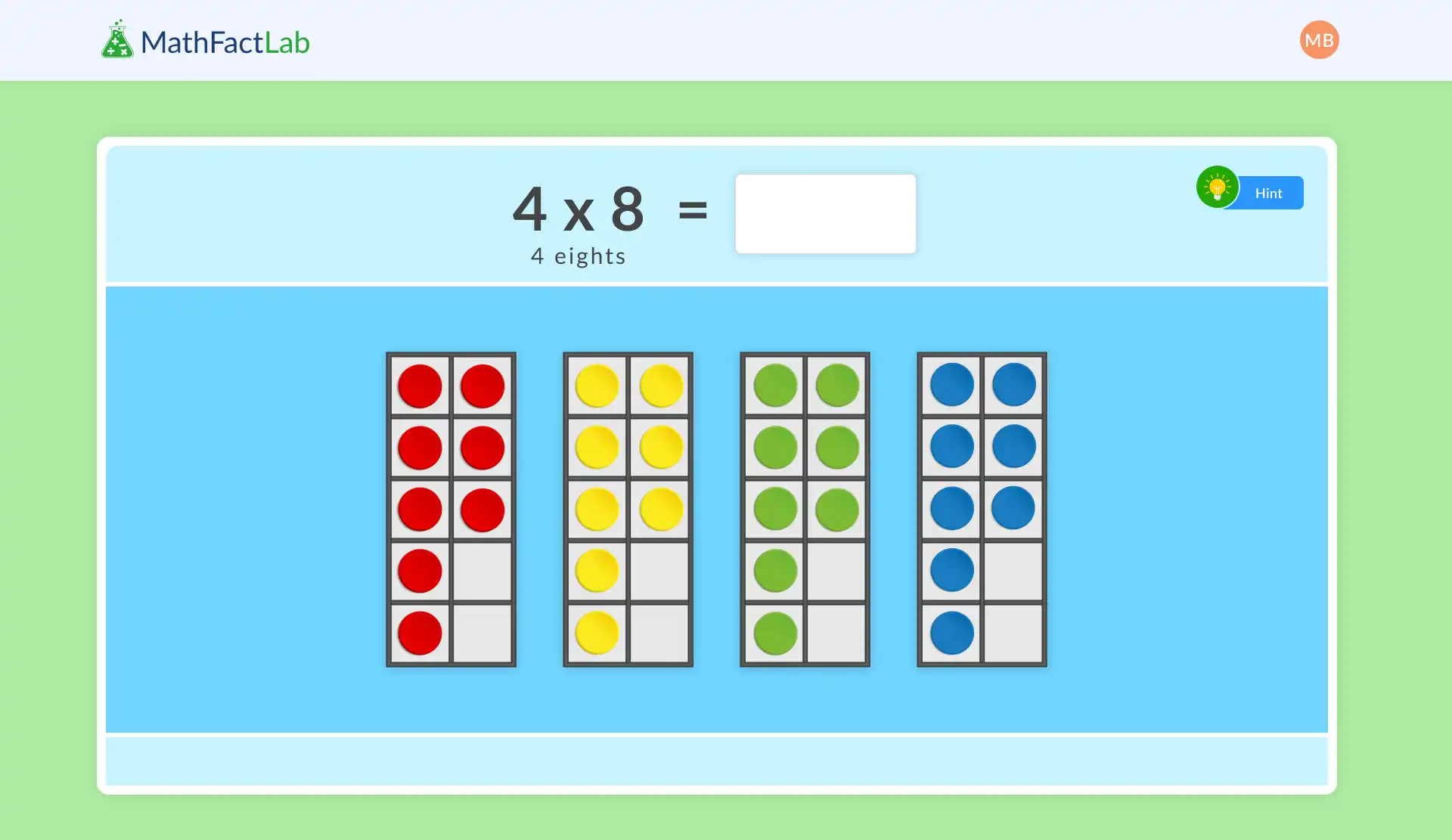
MathFactLab multiplication question showing 4 x 8 with four ten-frames filled with red, yellow, green, and blue counters.
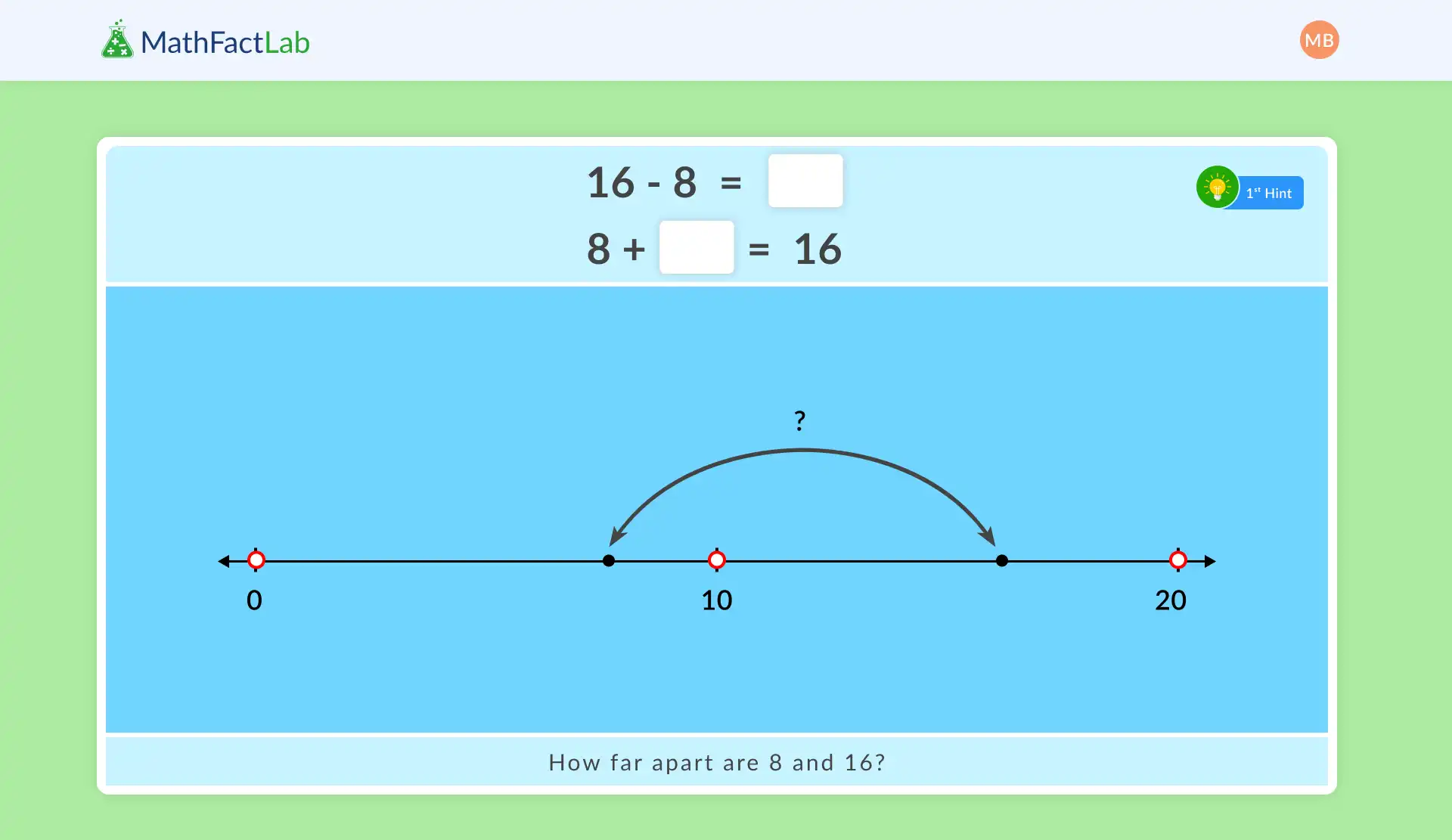
MathFactLab screen showing subtraction and addition problems with blanks, a number line from 0 to 20, and a question mark indicating distance between numbers 8 and 16.
MathFactLab division problem showing 42 divided by 7 with blank answer boxes and a fact family triangle with numbers 42, 7, and a question mark.
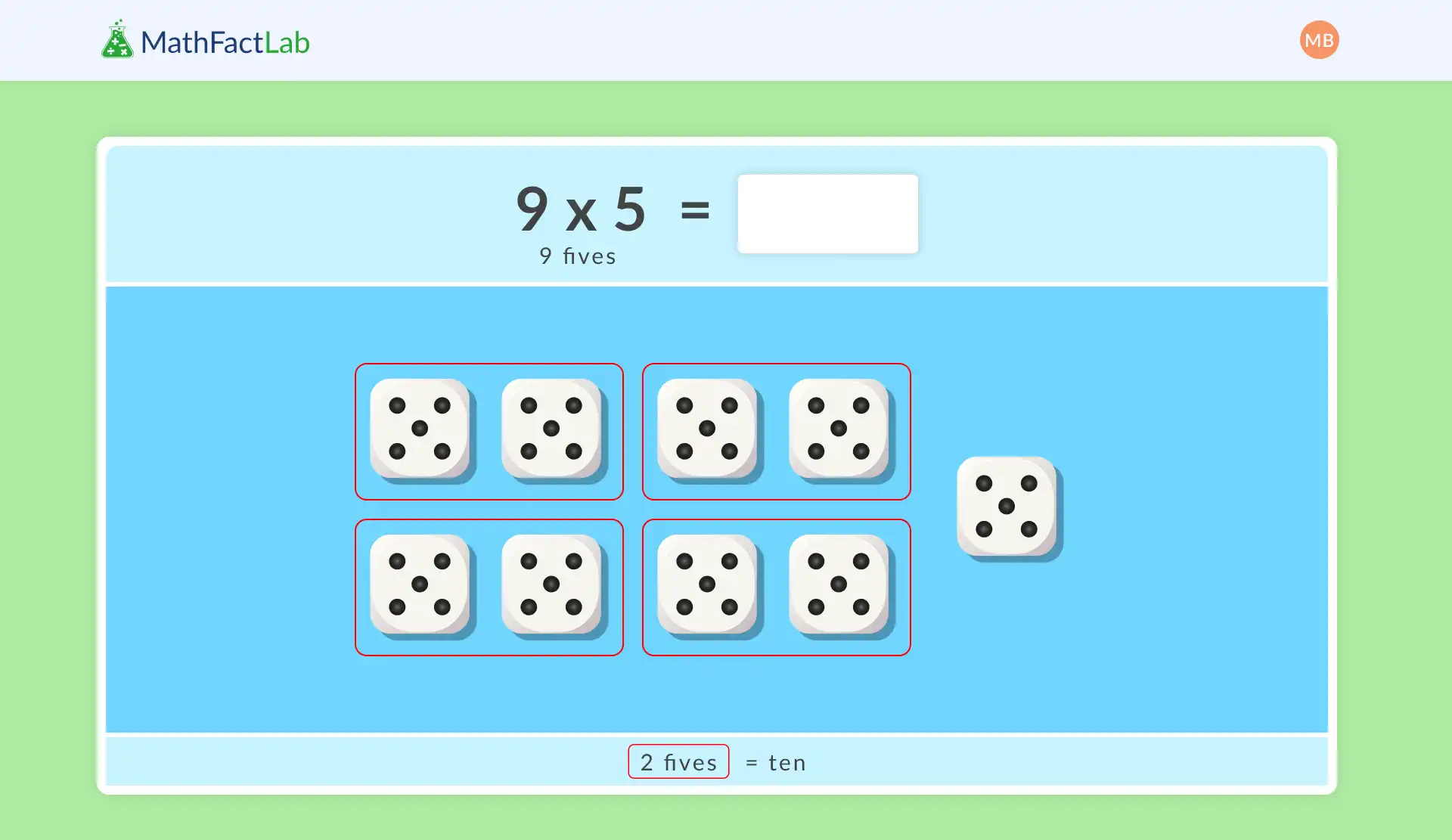
MathFactLab multiplication exercise showing 9 times 5 with groups of five dice arranged in fours and one single die, illustrating 9 fives.
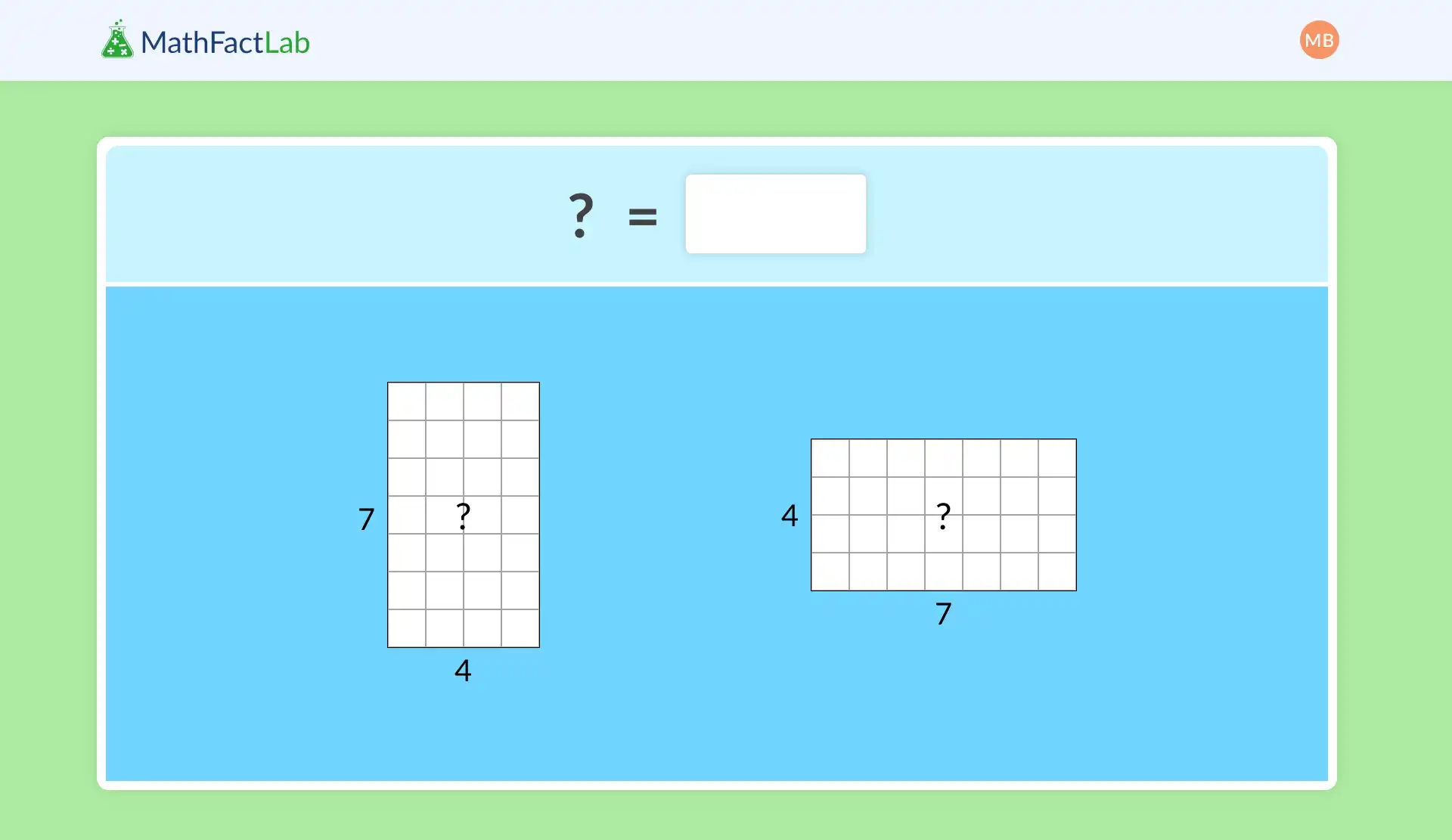
MathFactLab exercise showing two rectangles with grid lines, one vertical 7 by 4 and one horizontal 4 by 7, asking for their area equivalence with a blank answer box.
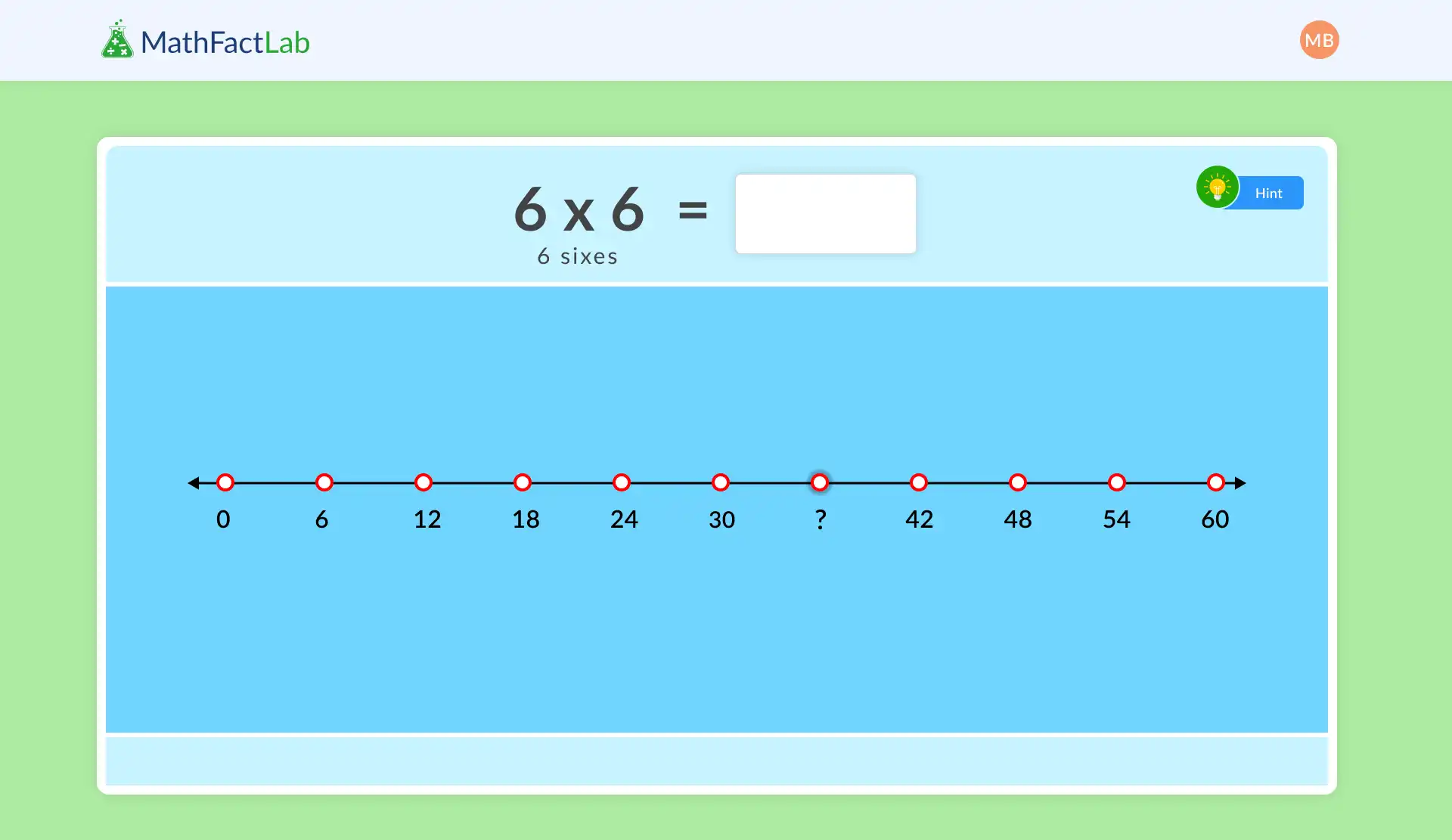
MathFactLab multiplication fact 6 x 6 with a number line showing multiples of 6 from 0 to 60, missing 36 at the question mark.
Illustration of two people standing next to a guide holding a red flag with text inviting teachers and administrators to schedule a personal tour of MathFactLab.

Our Emphasis is on Understanding

At MathFactLab, we represent each of the basic math facts with a variety of models. This helps our students to understand the basic facts in multiple ways and to recognize them as components of math fact families, whether we are talking about addition facts, subtraction facts, multiplication facts or division facts.
For example, as our math students practice basic multiplication fact fluency (alongside division fact fluency), they may see these problems represented with number lines, dice, bar diagrams, open arrays and area models, to name a few. These math fact strategies help our students to realize that they can construct new math facts with previously mastered ones.

What Our Customers Are Saying

Our 4th grade implemented MathFactLab last year. By the end of the first quarter of the school year, I had a math teacher with 20 years of experience come to me and tell me how much more successful his students were with math fact acquisition and automaticity than he had ever experienced. On top of that, our students regularly shared how much more they liked MathFactLab than other programs that we had used.
Nick
MTSS and Math Interventions Coordinator, Pennsylvania
I [am] not hyperbolic in saying that MFL is the single best thing I have used in math class in my 25 years of teaching. It supports our philosophy, our adopted Illustrative Math program, and our kids. When I first signed up two years ago for the program, I entered myself as a student to see first-hand what it does. Of course, I had to stop because I have to plan lessons and there is only so much time in the day, but I was IMMEDIATELY humbled by 9-year-olds who practiced and exceeded my skills! And kids I used to teach random sing-songy mnemonics to were finally LEARNING relationships. I cannot say enough.
Jennifer
Teacher, Ohio
Our school transitioned to MathFactLab two school years ago to provide supplemental math fluency instruction to our students. We were seeking a resource that provided instruction and not simply drills of basic math facts to ensure student understanding. We found that MathFactLab not only helped us reach our goals for significantly improved math fluency and efficiency, but also that students were highly engaged and willing to work through the levels as expected. We believe in MathFactLab!
Ashlee
Elementary Principal, North Carolina
I used a pilot license at the end of the school year last year, and the gains I saw with my students in just those last few months inspired me to use some of my budget money to purchase the program this year for my students so they would get the full year of benefits. My new students started using it this week, and today during math, one of my students credited her understanding of today's lesson (finding equivalent fractions using factors) to a strategy she learned on MathFactLab already! I know this is really going to give my students a leg up in their math skills this year!
Carla
Fourth-Grade Teacher, Maine
MathFactLab is easy to use, motivating for students and best of all uses strategy-based learning to teach fact fluency.  As a third-grade teacher, I can differentiate for all my students.  Whether they need to still work on their addition facts, or they are ready for division facts, MathFactLab is a great resource to help students achieve fact fluency.
Christine
Third-Grade Teacher
I just finished a staff training on numeracy for secondary students. I am on the verge of tears over how amazing of a resource you have here, aligned to some of the best research on student success. Thank you, thank you, thank you so so much for what you are doing, and please do not stop!
Joshua
Secondary Special Education Mathematics Coach
I just wanted to thank the creator of this program! I am using MathFactLab daily in the classroom. My lowest of learners are benefiting from it and so are my high fliers. I can't thank you enough for this. I have been looking for this program for years. Please be sure to thank the teacher who created this!
Heidi
Sixth-Grade Math Teacher, MA
We love how easy MathFactLab is to use! We know that all of our students don't learn the same way so we appreciate that there are so many different ways for students to practice their facts. I love that subtraction and addition are taught in cohesion as they should be! Our students are becoming goal setters and detectives to figure out what they need to do to unlock the Level Lifter. I had a 2nd grader say to me "I know my accuracy is high so now I just need to work on getting faster!" In my 13 years of teaching, I've never had a student self-diagnose what they need to do to improve! As a teacher, I can easily track my students progress and celebrate milestones. There are several options that help me make adjustments to help students who are not progressing like others. We have piloted the use of MathFactLab with our 2nd graders and we have seen many successes! We hope to share this with the whole staff for next school year!
Amanda
Math Specialist/Interventionist, Kansas
This has been an incredible help for my 7th-grade students who need strategies for mastering basic facts. Having a variety of strategies to use and practice has made a huge difference.Thank you so much for MathFactLab! It is a game changer.
Amy
Seventh-Grade Teacher, Michigan
Thank you for creating a website that connects the models to the equations - This is perfect for new multiplication and division learners. I've been teaching third grade for over 20 years, and this website is the absolute BEST!! Thank you so much.
Stephanie
Third-Grade Teacher, Tennessee
We are a single-stream school in regional Australia and I wanted to write and say a massive thank you for creating the product you have. Our students have been growing so fast with their number facts that we have all agreed as a staff to commit to daily use of MathFactLab in addition to our daily reviews and core maths lessons.
Anthony
Teaching and Learning Coordinator, Australia
I think the program is the BEST one I have ever used for helping my kids develop conceptual understanding of math facts and acquire mastery!!  My students really enjoy the program as well.  I think it is FABULOUS that the program offers visual supports, combines the inverse operations, and progresses sequentially in difficulty and cognitive demand.  Most programs focus on single operation at a time. Seeing the connection between addition and subtraction and multiplication and division and learning those facts simultaneously is so very beneficial!!!!  Thank you for all your work and genius in creating this tool to help our kids.
Susan
Fourth-Grade Math and Science
We have used MathFactLab this year in 3rd and 4th grade and it has brought A LOT of success to our kids! We LOVE it. We may be your biggest cheerleaders for the product…. We tell everyone how great it is (and unique).  It truly is the BEST program out there to help students develop math facts along with concept development and strong reasoning. There truly is nothing else that compares. And believe me, I have searched (33 years teaching).
Same Teacher
One Year Later
I am a career math specialist who now runs a math resource website while continuing to privately tutor and teach small group math classes. The most common question I get from parents is how to help their children learn their math facts! When I work with middle school and high school students who never learned their facts, they are slowed way down on their upper level math and make mistakes in their calculations. When I first heard about MathFactLab, I tried it out with students ranging from 1st grade all the way to 10th grade. I was so impressed with the visual representations and strategy-based practice. Unlike other fact practice sites, the kids don't complain about this one. More importantly, they learn their facts! MathFactLab is now the only fact practice site I recommend, and I have recommended it to more people than I can count!
Amy
Math Tutor, Texas
Just so you know, I love MathFactLab. I used it last year with my 5th-grade students and saw so much growth in their fluency and use of strategies throughout my math block.
Patricia
Fifth-Grade Teacher, Georgia
Thanks for the information and quick response! A few celebrations for your fact fluency program- I like that you introduce new facts in a logical order, as opposed to x1, x2, x3... I like all the different models and strategies. I like that multiplication and division is worked on at the same time. I like that you have thought of students with processing issues and that you give the teacher the ability to adjust time and whoopsies for individual students. I like the concept of "level up" as opposed to "testing". I am having to play with it to make it work for some of my students, but I think it is a great way to practice for fluency, flexibility and accuracy with math facts. Thanks for creating MathFactLab.
Janine
Third-Grade Teacher, Illinois
MathFactLab has been a game-changer for me. I have been using it for almost 4 years. I love that it is individualized and allows students to progress from level to level at their own pace. The new reset feature will be a great way to start the year, allowing the students to review some of the facts they may have forgotten. The best part of the program is that students love it!
Colleen
Math Interventionist, Vermont
Hello! I co-teach 40 third graders with another teacher and we recently launched MFL. We absolutely love what we're experiencing so far! Thank you for making this program available! Our kids say they love that there are a variety of strategies used and taught, there is more color than the other fluency program we used, they feel more supported in that they have more time to solve the problems, and this program does not just automatically provide the answer. We're in love!
Kathryn
Third-Grade Teacher

Strategy-Based Math Fact Fluency

Students working on addition fact fluency (alongside subtraction fact fluency), will practice with ten frames, rekenrek beads, number lines, and double-bar diagrams. This will help them see that the addition facts and subtraction facts form math fact families, which greatly simplifies the process of learning the basic facts.
Frequent exposure to these visual models helps our math students to construct mental models and deepen their conceptual understanding of the basic operations. Division and multiplication facts suddenly become two sides of the same coin! All this helps to build a foundation for overall math fluency.
When students regularly complete math facts practice online with MathFactLab, they begin to see the manifold patterns and relationships that interconnect the basic facts. This, in turn, leads to easier mastery, increased engagement in math class, and greater student success in mathematics.
Math teachers, whether your elementary students need practice with addition facts or multiplication times tables, MathFactLab will serve them well!
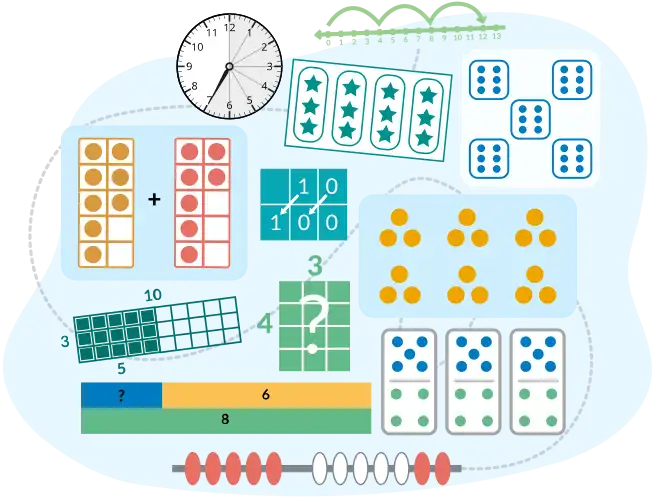
Collage of math learning tools including an analog clock showing 8:23, number blocks, dice, abacus, star cards, and a number line with addition and question marks.

You’ll Love MathFactLab

It's easy. Setting up your class is simple and straightforward.
Make accommodations to meet individual student needs.
MathFactLab reinforces your good classroom teaching with individualized, online math facts practice, developing a wide range of math concepts and skills.
MathFactLab pre-assesses students and places them appropriately within the math fact fluency program.
Easily monitor student progress at all grade levels with our intuitive teacher tools. Quickly see who needs extra practice or assistance.
Your students will take pride in their growth as they progress through the program.

What the Research Says

The best way to develop fluency with numbers is to develop number sense and to work with numbers in different ways, not to blindly memorize without number sense.
- Jo Boaler
Stanford University Professor of Mathematics Education and Co-Founder of You cubed, in her article Fluency Without Fear: Research Evidence on the Best Ways to Learn Math Facts
Many studies over many years have compared traditional basic fact instruction (i.e., drill) to strategy- focused instruction. All of them show that strategy groups outperform their peers on using strategies and on automaticity and accuracy.
- Jennifer Bay-Williams & Gina Kling
Math Fact Fluency: 60+ Games and Assessment Tools to Support Learning and Retention. citing research from Baroody, Pupura, Eiland, Reid, & Paliwal, 2016; Brendefur, Strother, Theide, & Appleton, 2015; Locuniak & Jordan, 2008; Purpura, Baroody, Eiland, & Reid, 2016; Thornton, 1978, 1990; Tournaki 2003
Mastery that underlies computational fluency grows out of discovering the numerous patterns and relationships that interconnect the basic combinations.
- Arthur J. Baroody
Professor Emeritus of Curriculum and Instruction, University of Illinois at Urbana-Champaign in his article Why children have difficulties mastering the basic number combinations and how to help them
Research supports the use of explicit strategy instruction as effective in helping all students learn (and remember) their basic math facts (e.g.,Baroody, et al., 2009; Baroody, et al., 2016; Thornton, 1978; Fuson, 1992; Rathmell, 1978; Thornton & Toohey, 1984).
- John A. Van de Walle, Karen S. Karp & Jennifer Bay-Williams
In Elementary and Middle School Mathematics: Teaching Developmentally, 2019